
Annie Louise is my mother’s doll. I always thought that she was a china doll, but when researching dolls and doll clothes from the early 1900s, I decided that she didn’t look like a china doll. She was a bisque doll. Her face is not shiny. I couldn’t find any dolls that looked just like her. She has a jointed leather body.
 Annie Louise is dirty and needs a new wig, along with new clothes. I’ve decided to clean her up and restore her. Pinterest has a site where it shows how to measure a doll and using a regular person’s pattern, cut it down for doll clothes. I have measured all of Annie Louise’s measurements. She is 19 1/2″ tall. Her bust line is the same as her waist. As I turned her over to measure her back, I noticed some letters on her neck. Now I know what she is.
The letters are AM95 4DEP The Internet is wonderful. This is what I found.
Annie Louise is an Armand Marseille doll. Located in Koppeisdorf, in the Thuringia region of Germany, the Armand Marseille doll company was the heart of the German doll making revolution in the 1890’s manufacturing 1,000 doll heads a day from 1900 to 1930. Armand Marseille was born in St Petersburg Russia and was a butcher before becoming a successful doll manufacturer.
By 1910, 800 workers were in the factory and home trade.
Almost all of Armand Marseille’s doll heads were made of bisque. He did not make his own doll bodies, but purchased them from other manufacturers. AM dolls were promotional dolls. The AM factory made doll heads in all price ranges, according to the buyer’s price range.
Montgomery Ward ordered cheaper dolls. I know that my Grandmother ordered from catalogues as she had an Aladdin home. It was purchased through the Sears catalog.
The dolls marked AM95 4DEP are not valuable according to the Internet. Most for sale are in Annie Louise’s condition. She is valuable to me because she belonged to my mother and is very pretty. I love her big blue eyes and the dimple in her chin.
My Great Grandfather was a photographer so I have photos of my ancestors in their beautiful dresses. Now that I know Annie Louise’s measurements and have instructions on how to cut from those measurements, I plan to recreate those dresses for Annie Louise. I’ll start with her undergarments. I haven’t made doll clothes for a long time. I should remember how after a few tries.
I’ve been saving fabric, laces and other items that I thought might be useful.
Soon, she will have a new wig. I think brown would be a good color for her. Maybe, I will consider blond hair because of her blue eyes. My mother told me that she had a long, real hair wig. My grandmother was very angry when my mother gave Annie Louise a short haircut.
With some bisque cleaner, her face would look much better. I’ve found a wonderful doll supply company. Now that I know what kind of a doll she is, I might be able to find more information on their site.
I already have a quilt for Annie Louise and enough fabric left over to make a matching dress or robe. This project will be a lot of fun.
I’ll post updates on her progress from time to time.
Have a great day and happy quilting.
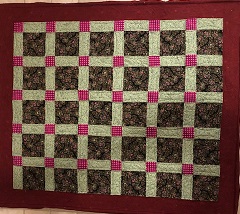 One of the reasons that I didn’t finish this one was that I ran out of fabric for the side and top outer sashing. It’s a good size for a baby quilt. The baby won’t notice. Better finished than perfect. Angela Walters has some very good YouTube videos. I’ve started to watch them and am going to practice whatever she teaches on my UFOs. On this piece, I practiced echo quilting with a ruler. It does make a straight line. The black squares are stipple quilted. The light green sashing has curved quilting. Angela showed how to both free motion quilt and ruler quilt curves. I free motion quilted the curves. I did find that the more I practiced, the better it looked. The red border is quilted with a leaf background filer. This piece will go into the giveaway bin.
 The second wall hanging was quilted with an even feed foot. It was just straight line quilted. I could have free motion or ruler quilted, but decided to just quilt it and have it done. After I finished it, I decided that it would look very nice as a topper on a white table cloth on my dining room table. I will keep this one.
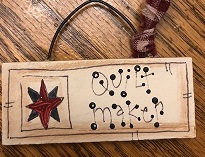 I quite often say that I am a quiltmaker, not a quilter. If a person makes tents, he is called a tentmaker, not a tenter. One of my friends gave me this pin today. I will wear it proudly and state that I am a quiltmaker.
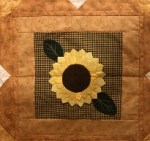 The center block had the dark background, It is a 3-D block. The sunflower petals are elongated prairie points. The leaves are two sided and attached by the vein stitching, It has two sashing borders. One is a light yellow and the outside border matches the fabric on the blocks that butt up to it. It is a straight set.
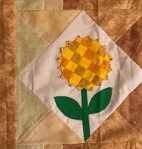 One of the side blocks has pieced small squares for the center with prairie points around it. The stem and leaves are appliqued. It is on point and has triangles at the four corners.
 The other side block is appliqued. It is on point and has triangles at the four corners.
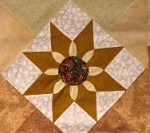 The top block is a star. The pale yellow fabric between the star sides is gathered at the base. It is on point and has triangles at the four corners.
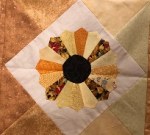 The bottom block is a Dresden plate. It is on point and has triangles at the four corners.
 That left one block and four corners to fill. That was the block that I had made. I cut the Dresden Plate block into four pieces and framed it. Then I added strips to make a log cabin that was the same size as the other blocks.
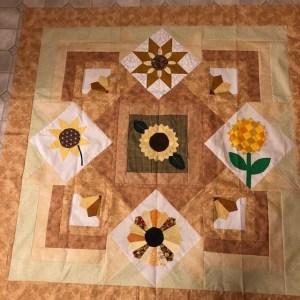 After the nine pieces were sewn together, I added a single gold frame. This wall hanging is different, but after all these years the blocks are finally ready to be quilted.
 Miss Molly quilts