A short while ago, a friend asked me how I put the rows of the Canadian 150 quilt together. The quilt had 12 rows of 12 blocks. It was hand quilted. Every week, we received a pattern and a story about an amazing Canadian woman. When I had received the patterns for 24 blocks, I put them together in two rows. Then I hand quilted the rows as I received and pieced the next blocks. Row 3 and row 4 were sewn together and quilted. Every section of two rows was pieced and quilted as a separate quilt. Following is the procedure that I used to add each section to the next one.
 I’m using a Linus quilt for the demo. It is made with nine patch blocks set three by four. I made two sections of two rows. The nine patches are quilted. I omitted quilting the sashing because I needed it to float. I also didn’t quilt the border because The quilting might not match up where it was seamed. I wanted to quilt it all at once. Most tutorials tell you to trim both edges even. This will work, but you sometimes have to pull it and the seam won’t lay flat. I find it better to make one edge 1/4″ wider to give a little wiggle room. It is less stressful. On this quilt, the side with the sashing will be the side that is longer. It was not quilted. That will give you more room to manipulate. It is the bottom piece in the picture.

Trim the top piece even with the edge.
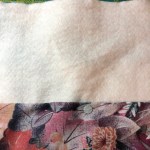 Turn the bottom piece with the sashing over. Pin the backing down and away from the edge. This will keep it out of the way of trimming. Turn back over and trim even with the edge.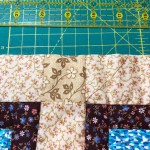
Trim the batting an extra 1/4″. This will eliminate bulk.
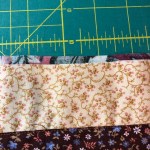 Unpin the back, smooth out, and trim back 1/4″ away from trimmed top.
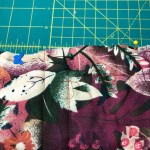 Pin backing down again to get it out of the way. Pin the two pieces together, right sides together. I use a lot of pins. Line up the sashing lines while pinning. Peek to see if they line up.
This needs to be adjusted. The right seam does not line up.
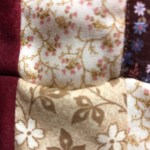
 Then sew seam with a 1/4″ seam.
 Take it to an ironing board. Laying it with top against the board, press seam up. Press 1/4″ on backing.
Lay backing over pressed up seam. It should cover sewing line. Press.

 When it is even, pin and then hand tack seam.
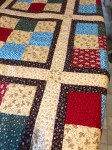 Done. You will not know that the quilt was quilted in small pieces. Using this technique, you can machine a king size quilt without a lot of tugging. You could even quilt single blocks and put them together this way. A patterned backing will hide the seams on the back. Or you could use different fabrics on the back and have a two sided quilt. There are so many options.
Have a great day and happy quilting.

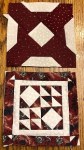
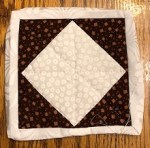

 A friend gave me some Dresden Plate blocks that were made in the 30’s or 40’s. They came with the muslin. I have appliqued the blocks onto the muslin and stitched the blocks together.
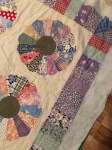 Fortunately, I had several 30’s Dresden Plates pieces that I purchased at auction several years ago. I was able to cut them to make the border. The fabric, even though it isn’t the same patterns, has the same look. It goes very well with the blocks.
 I bought a piece of green 30’s fabric from a vendor at the Guild quilt show, intending to use it for something else. It just happens to be the right size for the back of this quilt. I think that I was going to use it with the auction Dresden Plate pieces. They’re both in this quilt now so I don’t have to think of what to do with them.
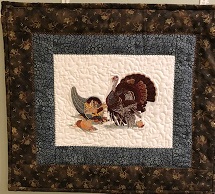 It’s November already. I finally changed the small monthly wall hanging. I hadn’t changed it since July. Sue didn’t go out trick or treating. She can today.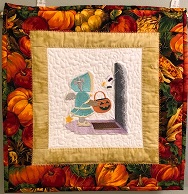
 When I was getting the wall hanging out of the drawer, I found another one. This was made for a Guild challenge many years ago. I’m not sure what the criteria was for the challenge, but I remember that we were given beads to use in the piece. It was hand quilted. The fabric was obtained at a Guild quilt show. Keepsake Quilting was a vendor at the show. They had a large bin of fabric. We could stuff a plastic shopping bag for a very small price. I knew that I would use the fabric some day when I bought it. It seems as if I have a lot of fabric that I bought that way. Some day, I will have a use for it.

 Miss Molly quilts