

Continuing on from the last post where you sewed pieces to strips, pressed them to one side and cut between the pieces. This is called a twosie. Now you place another strip on the sewing machine, right side up. Add the twosie, right sides together and sew, making another big pile. It doesn’t matter which way you sew the twosie to the strip. Then, as before, press to one side and then cut apart. This is a “threesie”. Continue adding the twosies and threesies to strips until you have a big pile of moresies. Don’t worry about matching seams. They are not matched in this block. If the twosies or threesies are the same size, you can sew them together with a strip in between them.
When the block is big enough, place the square ruler ( 6″ or 6 1/2″) on the piece at an angle. Always use the same size ruler for each project. Move the ruler around so that the corners don’t come at a seam. Rotary cut the block. Every block will be exactly the same size. Continue until you have enough blocks for your quilt. Remember, most of the edges will be on the bias, so handle carefully. The bias edges will be taken care of when you add the sashing.
Arrange the blocks on a design wall, making sure that the colors are distributed equally.
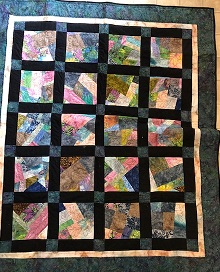
Cut the sashing strips the length of your ruler and either 1 1/2′ or 2 1/2″ wide. The choice is yours. Also cut corner blocks. Sew the sashing strips to the block with the block on the bottom. Hold the beginning and end of the seam and let the feed dogs do their work to make the bias edges fit the sashing. Note the above picture to see how to place the block in the sashing and corner squares.
Add a 4″ to 6″ border. If the quilt is large you can add a 1″ border, a 3″ mile a minute border” and a 4″ border for a total of 8″ on each side.
To make the 3″ mile a minute border, piece together mile a minute scraps. You can incorporate the cut off pieces form the blocks. Cut the pieces 3 1/2″ wide. Square off the ends and add the pieces together until you have strips long enough for the quilt sides.
The quilt should be machine quilted or tied. There are too many layers for hand quilting. This block can be used in any other quilt block pattern that has a 6″ section. It is very nice when used in a stripy quilt Just add one block on top of the other for some of the strips.
I will continue with more tips for the Mile A Minute block in the next post.
Have a great day and happy quilting.


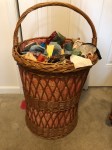 The basket with just the pieces, after the strips, small pieces, and partially sewn Mile A Minute blocks were removed.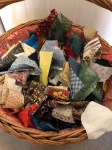







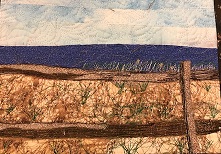
 This is a picture of the White Mountains in New Hampshire. We had many trips up North.
 We fished many ponds and lakes, but one time we went up the Merrimack River. It was a beautiful ride. This bend of the river was very pretty. We didn’t catch any fish, but if we did, we would have let them go. Even though the Merrimack is cleaned up, I can still remember when it was polluted.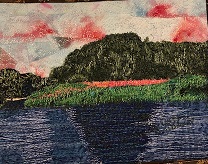
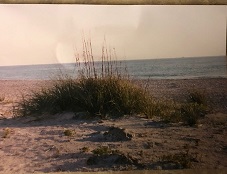 For several years, we spent a week in Bradenton, Florida. Our motel was close to the beach and we walked the beach every day looking for shells. There was a restaurant close by and we were walking there the day that I saw this clump of grass.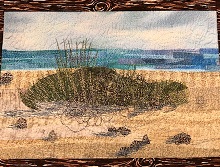
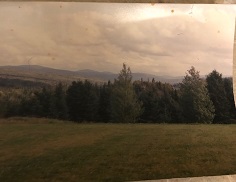 Before we retired, we spent every Memorial Day and Labor Day at a cabin in Pittsburg, New Hampshire. The fishing was great and we went looking for moose every evening. They were by the side of the road every dusk. This was the scene across the road from our cabin.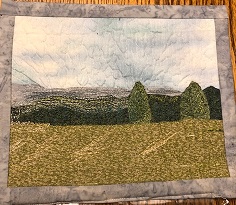
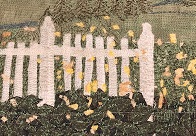 This last one doesn’t have a picture with it. I probably had one at the time that I made the picture. This is the scene from my porch in Maine. The road goes from left to right at the top of the picture. My neighbors driveway is across the field just beyond the row of trees. There are gardens on both sides of the white picket fence. It must be fall, because the flowers are perennial Maximillian Sunflowers.
 Annie Louise needed a new outfit for April. Looking through the pictures of my ancestors for inspiration, I decided to make a white blouse and a black skirt.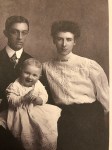
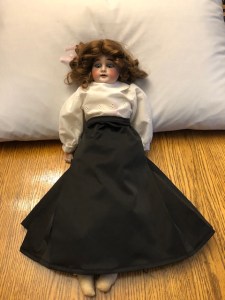 Annie Louise looks very elegant in her new skirt and blouse. It will be her shopping outfit. She already has a housedress, a white fancy dress for a party and an older dress for cleaning house.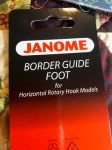
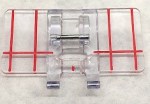
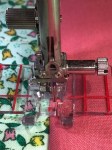 I needed to top stitch a band on the top of the quilted fabric. With the red center line on the edge of the band and the needle moved to the right a little, I was able to perfectly top stitch.
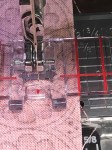 The pattern called for 1/2″ seams. The first red line is exactly 1.2″ away from the center. Placing the line on the edge of the fabric gave me a perfect 1/2″ seam.
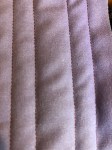 Alternating the red lines will give a different look to channel quilting.
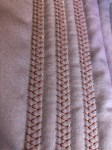 This foot can be used when sewing several lines of a built in embroidery. The lines will be perfectly even. Putting the red horizontal line on the first stitch of the completed line will line up the pattern.
 I found a yard of colorful floral fabric that I bought at Mardens. It has red, blue and yellow in it and is great for the focus fabric. I could add tints and tones from those colors. I also have a yard of beige fabric. I have several small pieces of shirting fabrics to use for the background. I seem to put the shirting aside when choosing fabric for a quilt. The bottom drawer has plaid fabric. I never put plaids in a quilt because I have to fussy cut them. Making one block at a time wouldn’t be that bad.
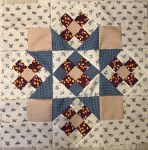 The first block was found in Quilting Cubby. They have a lot of very interesting quilts on their website. This block has five nine patches set on point. The nine patches have triangles in each of the four corners. By using a different fabric in some of the triangles, a star appears. The four corners have just three pieces. Now that I’ve made one block, I don’t have to make the quilt.

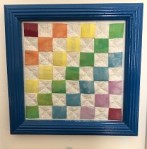
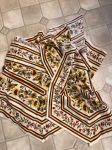 Eight years ago, I bought some sunflower fabric. I originally intended to finish the sunflower blocks of the month that I won at a Guild meeting. The fabric had stripes so I changed my mind and cut out some 60 degree triangle pieces. Then the fabric was put away. When I found the box of ufos in the attic, the partially finished pieces were there.
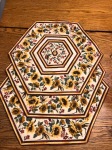 three table toppers
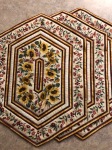 three place mats
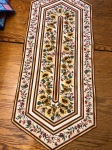 one table runner
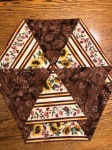 two table mats with a fabric addition because the prints were different.
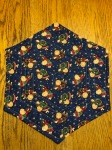 The sunflowers will be cheery in August and later on in the fall. Then I can flip them over as the background is a Christmas print. I was at a local Guild show in Maine and there was a table of fabric for sale. I bought yardage that would make a great table cloth and this was the coordinating fabric.
