I’m back in N. H. The weather is beautiful. My climbing roses are outdoing themselves this year. Two of the flowers that my Dad gave me are in blossom. I look forward to them every year. I did make a list of what I “needed” to do when I came home. I haven’t even looked at the list. I’ve been busy.
Last Friday night was the Guild banquet. Our speaker was Beth Helfter. Beth devised a new method of making half square triangles. It is called the Accordion sewn Half Square Triangles. It was fascinating because I need to make lots of half square triangles for a border of a wall hanging that I am making. Today, I thought I would make some. It took three tries to get the procedure into my mind. There are four steps in the procedure. It’s really very easy and quick to make the half square triangles. My final border will be finished very quickly. Then I can think about quilting the piece. This quilt is a challenge that will be revealed in September.
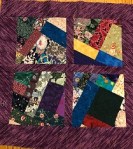
 I took two small partially hand quilted to Maine with me. I started both of them many years ago. They both have been sitting around for a long time. I decided to focus on one of them and finally finished it. Hand quilting is very relaxing. It just fits on the center of my dining room table. It will be my decoration for the month. This quilt pattern is one of my favorite patterns. It is easy with all straight sewing.

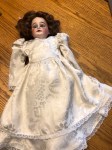 It’s June and Annie Louise needs a new dress. Last month, my Maine chapter of the Pine Tree Guild had a teacup raffle. My numbers were drawn for a few doll and doll dress patterns. I also won a bag of fancy fabric. Because it is June, Annie Louise had to have a bridal dress. One of the doll dress patterns is for an 18″ doll. It was perfect. Thank you, Shirley. There was some white brocade in the bag of fabric. Thank you, Brenda. Putting them together made a very nice dress.

I think that it is time to look at my list and start doing what I need to do while here. I know that one of the things to do was to find some more UFOs to finish when I go back to Maine. One other thing to do is to gather supplies for classes in Vermont. I should get busy.
Have a great day and happy quilting.
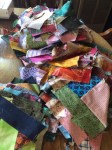
 When I finished piecing the Mile A Minute blocks today, I still had a small pile of fabric left. I’ve put it aside and will use it for a three inch border when I get to that point. When I make a Mile A Minute quilt, I usually make three borders. The first is a small border. The second is a Mile A Minute and is a bit larger. The third is larger still.
 With all that work, I have a little over 200 blocks. That is enough for several quilts. I have already planned two quilts on EQ7. Several more are in my head. That is for a later time. I will find fabric in N. H. to finish a few and make them the “Focus” of the day sometime later.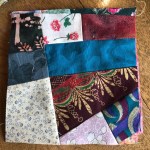

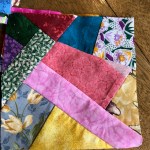
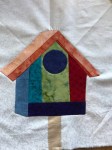 The Internet is wonderful. I downloaded images of several bird houses. I was able to enlarge the images and used the computer as a light box to draw the bird house. Ideas from several houses were used. The designing took most of the morning. I couldn’t make a fusible applique as the Misty Fuse is in N. H. Paper piecing was the answer. I paper pieced the house and then hand appliqued the whole piece down. That was all I did on that day, A piece started and finished. Focusing worked for one day.
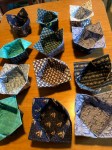 Today. I finished the 12 fabric boxes. All the hand sewing is done. They just need the buttons which are in N. H. The boxes are in the suitcase, waiting to go South. Sewing the buttons on the boxes will be my focus for one day. Or evening while watching TV.
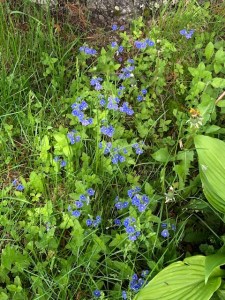 The pretty, little purple flowers are under the birch trees again. I don’t know what they are. I didn’t plant them. They come every June for me to enjoy. The lupine are almost ready for their display.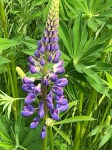
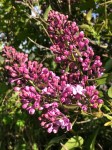 The lilacs are in blossom. The deer must have come into the yard as one of the bushes just have blossoms on the top. When the deer are hungry, they eat all the buds so there are no flowers. One year when the bushes were smaller, we had one blossom on the top of one bush. So far, they haven’t found the Hosta. Last year, they ate them down to the roots.
 The crab apple trees are beautiful. The Lupine has started to bud and should blossom in a week or two.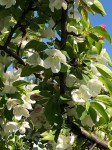
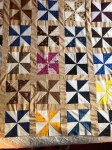 I’ve been working on several projects. One of the projects that I brought from N. H. was a plastic bag of quilt pieces that I received from a friend. I had no idea what was in the bag but thought I’d do something with it and get it out of the UFO pile. I found over 100 six inch pinwheel blocks and some sashing material. Three rows of 10 blocks were sewn together. It is very hard to sew something that someone else has started. Her 1/4″ seam was not the same as my 1/4″ seam. I really didn’t want another large quilt to sit around waiting to be quilted. I unsewed the three rows and removed three blocks from each. I had enough blocks to make three charity quilts. Two were 5 x 7 blocks and the third was 6 x 7. The three quilts are in the suitcase waiting to go back to N. H. They need a border, batting and a backing. All of that is in my sewing room in N.H. I didn’t bring any extra material to Maine this year.
 Another project was twenty four 10″ blue blocks. When I finished the Canadian 150 quilt, I cut the leftovers into 10″. 5″ and 2 1/2″ squares. I decided to make 12 fabric boxes. All 12 are sewn and turned. Once turned and pressed, each one has to be quilted. Then with a few seams, they turn into little boxes. I have three finished up to this point. They need some hand tacking and then buttons to hold the points down. Again, the buttons are in N. H. When they are all finished, up to the addition of the buttons, they will go into the N. H. suitcase. I can finish them there and not bring them back to Maine.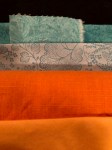
 A1is called Pinwheel Gone Awry. The center is a pinwheel, but the surrounding pieces look as if the pinwheel was broken.
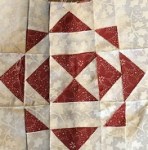 A2 is called One-Two-Buckle My Shoe. It was named because it was the 2nd block in row1, so after row 1 – block 2. Buckle My shoe just followed.
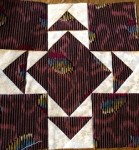 A5 is called Cathie’s Camping. There was no information in the CD to tell who Cathie was or why she was camping.
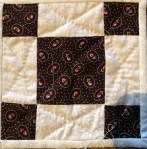 A6 is called Uncle Homer. The CD states that it was called that because Ruth used a piece of fabric in this block that had a farm on it and it reminded her of her Uncle Homer. I wondered who Ruth was. Brenda Papadakis, who wrote the Dear Jane book and drew all the patterns, listed all her quilting friends who made the Dear Jane quilts that were in the book. Ruth was not listed as one of her friends. She did mention Ruth Levin of the Bennington Museum. Maybe it was her. Although, it did not say that Ruth Levin made a Dear Jane quilt.
 The sun is finally out after a long day of cold, drizzly weather. There has been a fire in the wood stove all day. Miss Molly has been sitting in the best seat in the house. She knows how to keep warm.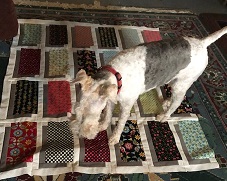
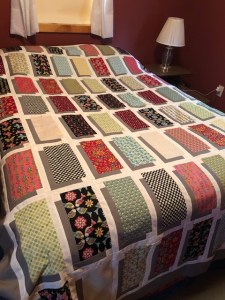
 The daffodils that are by the road have gone by, but the ones in the front yard waited for me to come up. They are a beautiful sign of spring. The gardens need a lot of cleaning out but that can wait until it is warmer,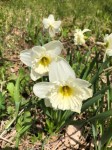
 Of course, the dandelions are in full bloom as are the forsythia.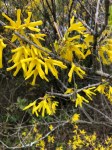


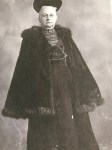 It’s May and Annie Louise need a new outfit. This month, the inspiration comes from my great, great, great grandmother. She actually lived, at one time, in the city where I now live. I have seen her house which was within walking distance to her husband’s job. He was superintendent of the sewer department. The city has recently pulled up and replaced the sewer lines that he installed in the late 1800s.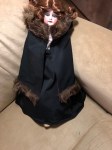
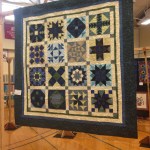
 Annie Louise’s quilt is back from the quilt show. Usually a dress is made and then a quilt is made from the scraps. This quilt was different. The quilt was made first. It was a Guild challenge. Then there was a lot of the blue fabric left over so Annie Louise has a house dress.