
One of the best things about being a blogger is to read the blogs of others who have the same interests. Recently, I read Laura Kates’s blog which she named “Crazy out of control scrap heap”. At the end she said “Who of you has solved the Scrap dilemma, and will you share your solution with me, a frustrated fiber artist. ”
I really haven’t solved the dilemma, but I’m working on it. In the past, when I took a class, the other students started placing their scraps on my table. I even robbed the waste basket after class. It was during the time that I was making my Garbage to Gaa-Barge art quilts. I used every little scrap for those pieces. I even made pieces with leftover threads. I had organized the tiny scraps in baggies. Each baggie was color coordinated. I used the colored fabric like paint. I threw nothing away. Now, several years later, I’m no longer working on that project and finally cleaned out that bin and threw most of it away. I felt guilty for about one half of a second.
 I still have lots of scraps. In a perfect world, I have a good system for taming them. Of course, I don’t always put them where they belong. I do have a bin for fabric that I might “file” in the right drawer some day. I bought four Ikea wire drawer units. They are stacked two tall and are in closets. The drawers can be removed and the fabric dumped out to check for what I need. These scraps are the larger ones. The scraps are folded and each color has it’s own drawer. There are drawers with Asian fabric, Ginny Beyer fabrics, solid fabrics, etc.
 There is a drawer with purchased pre cuts and panels. It would be nice if the fabric would stay folded, but after looking through a drawer to find what I need, I don’t always refold.
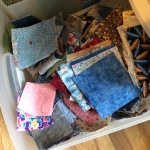 Once in a while, when I finish a project, I will make my own precuts. I cut 10″, 8″ 5″, 3 1/2″ and 2 1/2″ squares. They are stored in a plastic drawer unit, waiting for the right project to come along.

 Then, there are the Mile A Minute scraps. They seem to grow overnight when I’m not looking. I thought that I had used them up but I found two big bins in the attic. Fortunately, I’m teaching a class at the Guild and will give them away to the students. The scraps are in all colors. I’ve separated them into strips and scraps. The fabric has been pressed and is ready to use.
 I kept the blue fabric that was left over from the Canadian 150 quilt in a separate bin that I bought at the Dollar Store. I’m making a few samples for the Mile A Minute class with this fabric. When the samples are finished, the left over fabric will go in the bags with the other fabric. Hopefully, all this fabric will be gone by the end of the class. Of course, I can always make a few more Mile A Minute blocks.
The best place to store scraps is in a quilt, so bring them out and sew them together. The quilt doesn’t have to be big. Table runners, place mats, mug rugs, tote bags, charity and baby quilts, etc. are all small projects that can be made quickly using scraps.
I hope that I helped you with your dilemma, Laura Kate.
Have a great day and happy quilting.
 It is so good to finish a few quilts and blocks. My plan is to take each UFO, one at a time, from the pile and finish it. I’ve finished two more Dear Jane blocks. There is one more pieced and quilted block to bind. After that, I plan to piece the block that is numbered A3. I had already pieced it, but I didn’t like the way it looked, so I will make it again. Row A will then be complete and then I will start piecing Row B. Dear Jane isn’t really a UFO. It is a long term project that I work on between quilting other things. Eventually, I will finish the quilt.
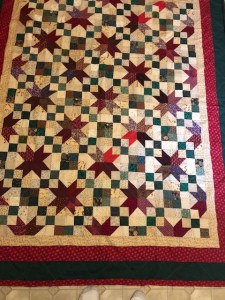 I found a partially quilted quilt hanging on a hanger in the closet. It has been an UFO for a very long time. I originally started to hand quilt it. The last time that I pulled it out, I machine quilted a portion. Yesterday, I finished machine quilting it and started to bind the quilt. It’s a planned scrappy quilt. The red and green fabrics make it look almost like a Christmas quilt.
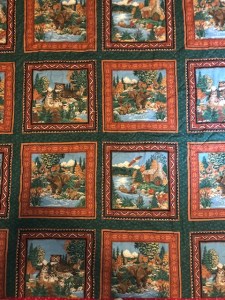 The back is a surprise. It is pillow panel of wild animals. The panel was one that I bought years ago when I purchased yardage from a discontinued quilt shop. I’ve used most of that yardage but I’m still finding ways to use the little bit of fabric that is left.
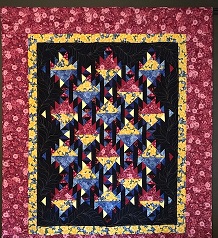 The new quilt was made in a class that I took in Vermont many years ago. The teacher told us what colors to use. They were out of my range of colors. When the quilt was finished, I didn’t like it. A few years later, I won a certificate for long arm quilting. I didn’t know the quilter or her work, so I decided to send this quilt to her. When I received it back, it was beautiful. She made the quilt come alive. Now, I like it very much.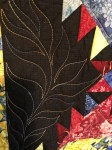
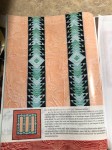
 Several years ago, I was flying from Salt Lake City to Arizona. As we flew over the canyons, I looked out the window and remarked that I would like to make a quilt in those colors someday. The quilt on page 30 had all the canyon colors.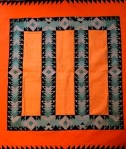
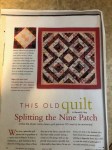 I was reading some older magazines that a friend had given me. In the May/June 2008 Fons and Porter Love Of Quilting magazine, I found an article by Gerald E Roy. It used a lot of half square triangles. I had cut a lot of scraps in 2 1/2″ squares and wondered what size they would finish if I made them in the accordion method. They finished at 2″ so I decided to reproduce the old quilt in this size.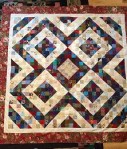



 Draw a diagonal line both ways on the one 5″ square. Layer two squares right sides together and sew 1/4″ on each side of both lines.
 Using the Tucker Trimmer, find the largest triangle, place the line on the stitch line and trim the edges. With a 5″ square, I could trim a 2 1/2″ square, making a finished 2″ square. Press open to the dark side.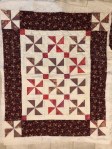
 I put everything aside and decided to play with the rulers and figure out how to use them. The solution for the crooked clam shells was simple. Originally, I started quilting on the bottom and went above the first row to quilt the second row. I couldn’t see where to line up the clam shells. I turned the practice piece around and quilted the clam shells on the bottom up side down. Then, when I quilted the second row, I could see the top of the first row and adjust the ruler to the right spot.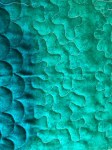
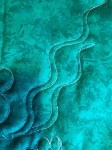


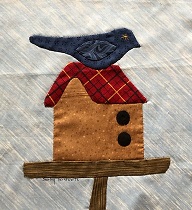
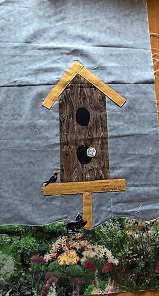
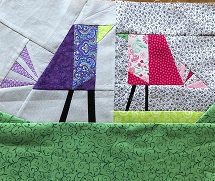
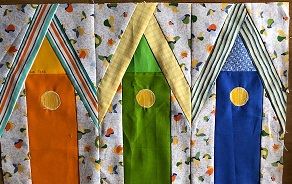
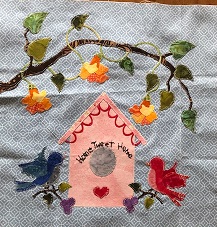


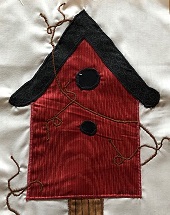
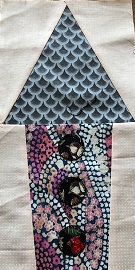 I have patterns for other bird houses and might add some more to the mix if I need more.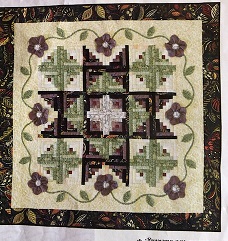
 It does take longer to make a mini quilt that one would think. There are as many seams, but they are shorter, The quilt finished at 22″ square. There are thirty six 2″ log cabins with two borders. I sewed a sleeve on the back in case I want to hang it on the wall, It’s also a perfect table topper.
 It was held in a church and the quilts were over the backs of the pews. Some quilts were hung. Every quilt was beautiful.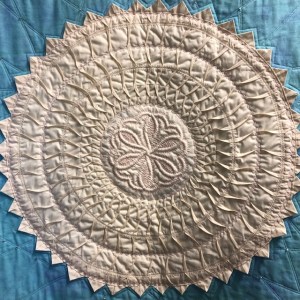
 This little dress has eyelet around the neck, so I think that I will make an eyelet skirt to go under the dress.
 This dress will make a top for a long sleeve plain dress.
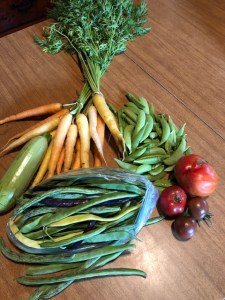 The produce at the farmers’ market is wonderful. I enjoy the variety of colors in the beans and the carrots, Somehow, they taste much better.
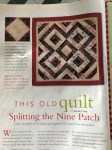 Fons and Porter Love of Quilting magazine has articles that are written by Gerald Roy. He is a quilt collector and appraiser. He is also a quilter, quilt judge, painter and antique dealer. His articles are called “This Old Quilt”. He shows pictures and talks about antique quilts that are in his collection.
 Her company is called EvaPaige Quilt designs. You can find several you tube videos on the Internet that show this method. It’s an easy method. Just take one step at a time. I needed a lot of half square triangles so I chain stitched ten units and then sewed several together when they became long.

 While the quilt looks as if the color was random, the center light design of the quilt consists of carefully chosen fabrics. When they are put together, there is an orderly arrangement. I decided to make the center first. Now, I can make the other nine patches and not think about color choices. When they are all made, I can put them together. The quilt is 10 by 10 blocks, so I have 96 more to make. I can make a few at a time when I feel like some easy sewing. I have enough split blocks and it is just a matter of trimming all the pieces down and sewing them together.





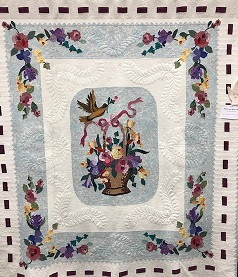
 Miss Molly quilts