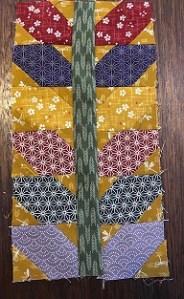
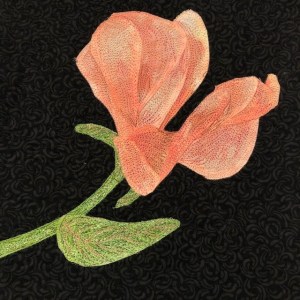
I needed a break from machine quilting so thought that I would finish one of the UFOs that I found in the attic. I also had to try out a small sewing machine that I had bought for classes and retreats. I’m going on a retreat in May and thought that I should see how the machine sews. It doesn’t have a thread cutter or automatic threader. It’s a basic machine. I bought it from a friend about one year ago and hadn’t even looked at it.
The UFO that I chose was a small quilt in a plastic bag. Several pieces had been cut out and sewn. How long could it take me? It was only 40′ X 40″. I couldn’t remember why I didn’t finish it.
I usually sew in the sewing room, but I decided to sew on the dining room table so I could look out the slider at the lovely spring weather. Actually, the weather is the same out of the sewing room window, but the back yard is beginning to green up.
All the pieces had to be pressed and organized. That didn’t take long. I read the confusing instructions and looked at the diagram. The instructions were in two parts. The first told how to make the components of the quilt. The second told how to sew the components together.
The first part was originally finished. Four 1 1/2″ x 18″ strips were sewn together. This was cut into four 4 1/2″ pieces. This is what the second instructions said – “Take a 3 1/2″ square an sew a strip of 1 1/2″ fabric to the left and right sides, trimming and pressing as you go. Next add strip to the top and bottom, again trimming and pressing as you go.” Repeat and make 25 squares. These squares measured 5 1/2″ x 5 1/2″. Five squares with borders and the first four were to be sewn into a 12 1/2″ nine patch for the center of the quilt. How can 4 1/2″ squares be sewn to 5 1/2″ squares? “. First error in the instructions. It should have said “trim to 4 1/2″ square”. I trimmed with a Tucker trimmer and the center was fine.
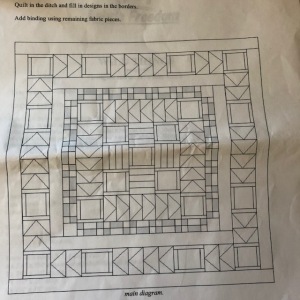
The quilt has a diagram for placement of the components. I count 21 squares with borders. Where do the other four squares go?
The 24 flying geese on the first border were already made, so they were sewn on. The next 2 1/2″ square and rectangle border had to be sewn. As I was sewing, the sewing machine started to slow down. It finally stopped and wouldn’t sew anymore. I will have to take a trip to the repair shop. I’m so glad that this happened here instead of when I was at the retreat. I went to the sewing room to finish on another machine. It was easy to make the 1/4″ seam the same on both machines.
Sewing was smooth out to the last flying geese row. The flying geese were sewn with no problem. The instructions are – “Sew your remaining flying geese together in pairs and join the left and right hand side pieces together, then attach to the quilt. Next, join your top and bottom pieces together and attach to the quilt.” Looking at the diagram, I made the strips. When I placed the strip on the main quilt body, the strip was 4″ short. After looking at it for a while, I realized that the four extra squares belonged in the center of the strips. It went together perfectly after a little unsewing and inserting.
 The instructions have been filed in the round file. It’s not worth passing it on to a friend. It’s a bright, cheery quilt and will look very nice on my dining room table. The quilt pattern was designed for a fabric line. Apparently there were animal squares to use for the 3 1/2″ squares. The title is “Wild Things”. That’s appropriate.
One UFO down, many more to go.
Have a great day and happy quilting.

 The quilt show is coming up soon. I still have one quilt to finish. The Five Yard International challenge quilt took much longer to quilt than I had planned. It is finally quilted. The binding is sewn on and partially tacked down. There are more than a few ends to knot and bury into the quilt. I’ll work on it tonight while watching TV. I will meet the deadline.
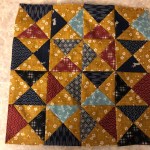 Block # 50 is a 12″ block It’s called Vintage and is designed by Sherri McConnell of a Quilting Life.
 Block # 51 is a 6″ x 12″ block. It is called Power Star and is designed by Lisa Bongean of Primitive Gatherings. This one took a really long time to make. It had ninety six 1 1/4″ squares and a total of 141 very small pieces. The little squares made twelve 2″ x 1 1/4″ flying geese and eighteen 2″ x 2″ square in a square units. That’s a lot of little pieces for such a small block.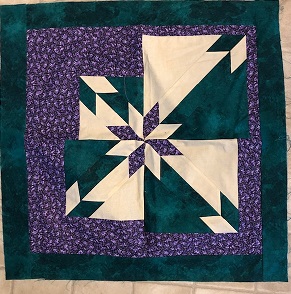
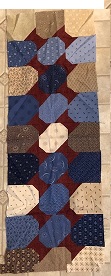
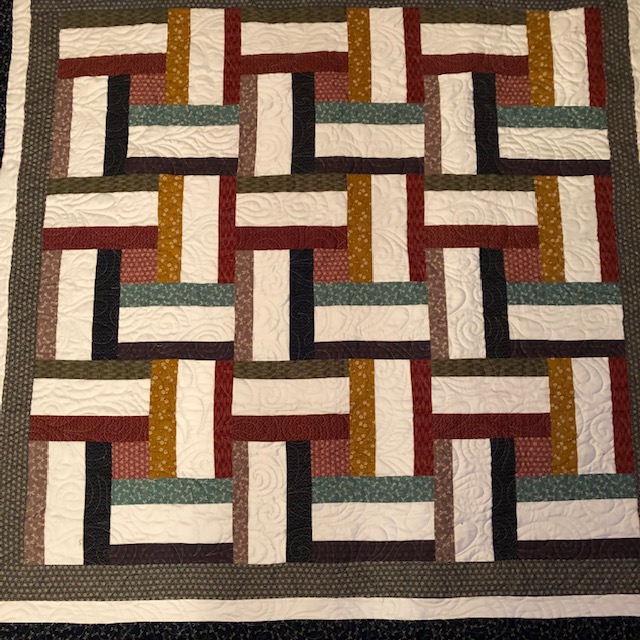
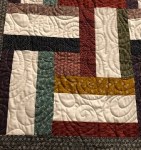


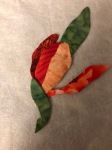
 This one is left over from a quilt that I made in a Deb Tucker class.
 This is one of a dozen table runners or table mats. Some are just the blocks, some are ready to be quilted.

 A long time ago when one of my daughters lived in Utah, we exchanged blocks. We were going to make an alphabet quilt. Each of us would make two blocks for every other letter of the alphabet. I started with A. She would make a block beginning with B. The A block is called Autumn. I finished one block and have the pieces for the second. The block is only 6″ so the pieces are small. She never did make B and I didn’t make C. Maybe we could start again. It was a fun concept.
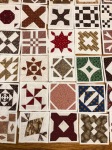 When I started making Dear Jane blocks, I intended to start in the center and work each row around the center block. Somehow, that plan has gone by the wayside and I am making blocks all over the quilt. About 1/4 of the blocks are finished so I have a long way to go to finish this quilt. I’m so glad that I decided to make the quilt in the pot holder method. That way, when the last block is made and attached to the body of the quilt, the quilt will be finished. All the remaining block patterns have been printed. Some of the blocks are very easy with just a few pieces. Others are much harder and need to be hand sewn. There are a lot of applique blocks. As soon as the Moda quilt is finished, the Dear Jane will be the only long term quilt to make. No more blocks of the week or the month for me this year. I have to many unfished quilts to finish.
 I designed the border of the Flower Quilt today. It was a lot of fun. I used the flower patterns that were in the body of the quilt. This is an unusual quilt as I decided the quilt size and designed the quilting pattern before I began. The flowers fell in place where they belonged. I’ll start appliqueing soon and show the progress from time to time.