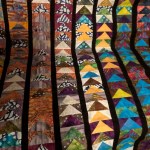
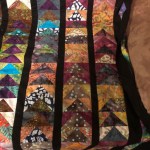
Orphan blocks are fun to work with. There is a reason why they were made and then put away. Getting beyond the reason and making a quilt from these blocks is hard to do. Years ago, I made several small blocks with the same pattern. I don’t remember why I made them, but I must have been learning a new technique.
 Some are pastel. Some are green and white. They are all very plain if left on their own.
 The pale green and coral blocks are set in a nine patch format. Five of the blocks are in a straight setting and four are in a diagonal setting. The center block is a straight setting with coping strips on four sides that enlarge it to the size of the blocks that are set in the diagonal setting. The strips are the same color as the outer border. The four diagonal set blocks have coping triangles. The triangles are two different colors which make a star. The four corners have coping strips on two sides. They are the same color as the outer triangles, which make it look like a border. There is a small outer border that is the same color as the star and then the outer border.
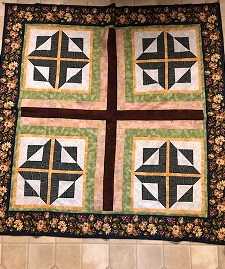 I wanted to do something different with the green and white blocks. They needed brightening up so I put two together with gold sashing. I auditioned several fabrics but couldn’t find anything that looked good. Then, I found the border fabric. I pulled the sashing colors from the border fabric and the quilt came together. It just happened. The inner border is small because that is all the fabric that I had left after making the larger sashing in the center. This quilt was a happy accident. Maybe I should call it by that name.
Most of my orphan blocks are together. I can see several quilts in the future. They are a little different than a UFO. A UFO just gets finished. When making an orphan block, you have to think outside of the box.
Have a great day and happy quilting.
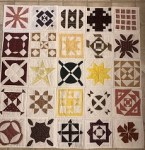 Twenty five of the center blocks are finished and pieced together. The blocks are hand quilted and then individually bound and sewn together in the pot holder method.
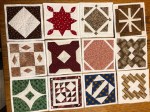 Twelve blocks are finished and waiting to be sewn to the main quilt.
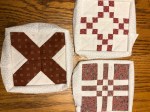 Three blocks are quilted, the binding is sewn on and is waiting for the binding to be tacked down.
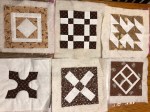 Ten blocks need to be quilted.
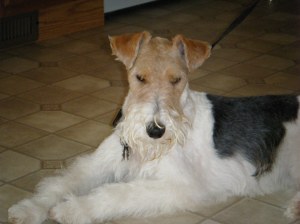
 Wire Fox Terriers are so cute when they are little.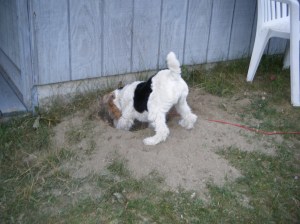
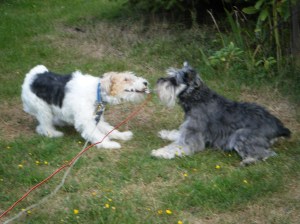 Her brother was Max, a Miniature Schnauzer. Max was an awesome dog. Usually an older dog teaches a younger dog how to behave. Miss Molly didn’t listen to Max at all. She became the boss when very young.


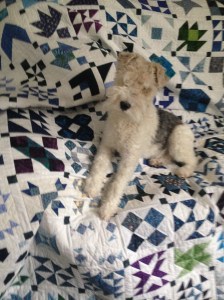
 The block is 18″ square finished and is made of flying geese. squares, and half square triangles. It was easy to make even though it looks complicated. Someone from the Guild will win all the blocks in a drawing. Even if I don’t win the blocks, I have the pattern and might make more blocks for my own quilt.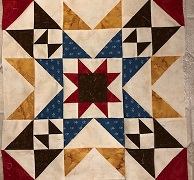
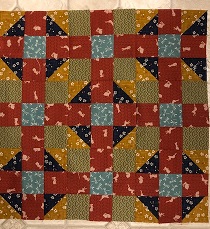
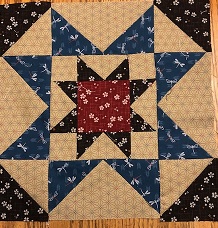 The next block was a 12″ square applique block. I didn’t want to make an applique block, so I substituted the draw block, leaving out one row to make it the right size. It was quicker to make that the original block. The omitted row had eight small half square triangles in the corners. Leaving out that row didn’t detract from the block. It looks like a star within a star block.


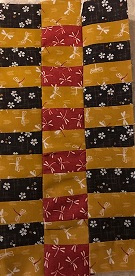
 I still have lots of the Japanese fabric to finish this project and make at least two more bed quilts.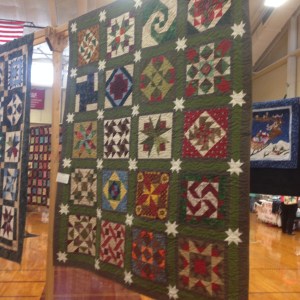
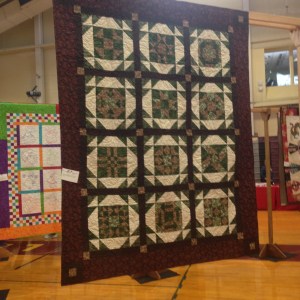 Using the white sashing with green triangles on the corner give this quilt a secondary pattern. Green stars pop up when looking at it closely.
 This quilt was designed for the quilter to find their own quilt patterns. Hints were: find a pattern that begins with the first letter of your first name. Find a pattern that has to do with weather. Find a pattern that has an animal in it’s name. There were many other hints. Every quilt was different. The quilter could choose the size of the blocks and the setting.
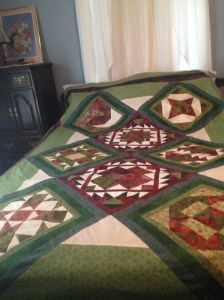 I don’t know why this quilt has only eight blocks. It looks as if I added fancy corner triangles to the two red center blocks to make them the same size as the outside blocks with the multiple sashing.
 Annie Louise is dirty and needs a new wig, along with new clothes. I’ve decided to clean her up and restore her. Pinterest has a site where it shows how to measure a doll and using a regular person’s pattern, cut it down for doll clothes. I have measured all of Annie Louise’s measurements. She is 19 1/2″ tall. Her bust line is the same as her waist. As I turned her over to measure her back, I noticed some letters on her neck. Now I know what she is.
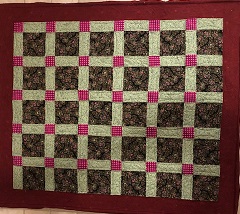 One of the reasons that I didn’t finish this one was that I ran out of fabric for the side and top outer sashing. It’s a good size for a baby quilt. The baby won’t notice. Better finished than perfect. Angela Walters has some very good YouTube videos. I’ve started to watch them and am going to practice whatever she teaches on my UFOs. On this piece, I practiced echo quilting with a ruler. It does make a straight line. The black squares are stipple quilted. The light green sashing has curved quilting. Angela showed how to both free motion quilt and ruler quilt curves. I free motion quilted the curves. I did find that the more I practiced, the better it looked. The red border is quilted with a leaf background filer. This piece will go into the giveaway bin.
 The second wall hanging was quilted with an even feed foot. It was just straight line quilted. I could have free motion or ruler quilted, but decided to just quilt it and have it done. After I finished it, I decided that it would look very nice as a topper on a white table cloth on my dining room table. I will keep this one.
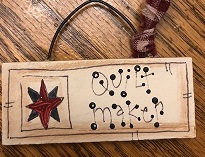 I quite often say that I am a quiltmaker, not a quilter. If a person makes tents, he is called a tentmaker, not a tenter. One of my friends gave me this pin today. I will wear it proudly and state that I am a quiltmaker.
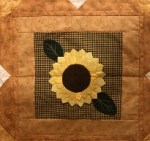 The center block had the dark background, It is a 3-D block. The sunflower petals are elongated prairie points. The leaves are two sided and attached by the vein stitching, It has two sashing borders. One is a light yellow and the outside border matches the fabric on the blocks that butt up to it. It is a straight set.
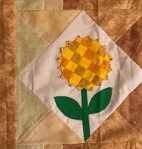 One of the side blocks has pieced small squares for the center with prairie points around it. The stem and leaves are appliqued. It is on point and has triangles at the four corners.
 The other side block is appliqued. It is on point and has triangles at the four corners.
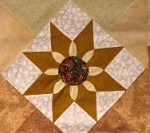 The top block is a star. The pale yellow fabric between the star sides is gathered at the base. It is on point and has triangles at the four corners.
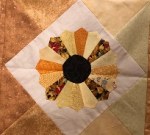 The bottom block is a Dresden plate. It is on point and has triangles at the four corners.
 That left one block and four corners to fill. That was the block that I had made. I cut the Dresden Plate block into four pieces and framed it. Then I added strips to make a log cabin that was the same size as the other blocks.
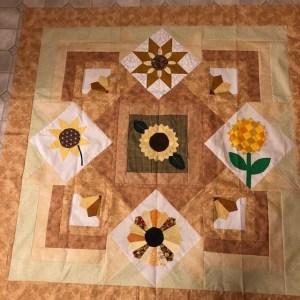 After the nine pieces were sewn together, I added a single gold frame. This wall hanging is different, but after all these years the blocks are finally ready to be quilted.
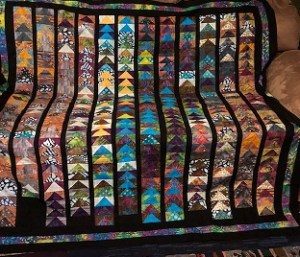 The Temperature Quilt top is finished. It has been fun watching the weather all year. It is one quilt that when someone asks me how long did it take to finish, I can honestly say one year (365 days). That’s not the quilting, just the piecing. I’m not sure if I will quilt it myself or send it to a long arm quilter. It turned out to be a big quilt.