
In yesterday’s blog about the Moda Blockhead 2 block having tiny pieces, I mentioned a class that I took while at the Vermont Quilt Festival last summer. The class was Tiny Piecing and was taught by Lynn Harris. The class description was – Learn tips and tricks that make working small easier, piecing tiny stars, and other small blocks as well as intuitive piecing.
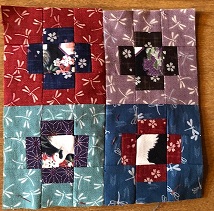
 I did enjoy the class, but decided that working small wasn’t what I really wanted to do. This is the piece that I made with the quarter square triangle finishing at 1/4″ It’s hardly visible. It is in the right block, bottom row. A four patch finished at 1/4″ is in the left block.
I also made a 3″star. 
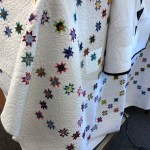 This is Lynn’s queen quilt made with 3″ stars. It is absolutely stunning.
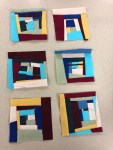 We were taught to improvise with tiny left over strips. These are my blocks.
This is Lynn’s quilt. I like the basic white with a little color. I might make something like this in the future. 
 Lynn’s blocks are amazing. She uses every last scrap of fabric. I think that if one started to make blocks with small pieces on a regular basis, they could be made up quickly. It might be interesting to make one or two after sewing a regular size quilt. They would add up quicker than you might think.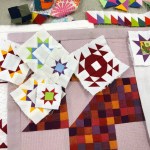
Have a great day and happy quilting.
 Block 22 in the Moda Blockhead block of the week project uses small pieces. There are four 3″ blocks within a 6″ block. It uses 1 1/2″ squares for the corners and centers of the 3″ blocks. They finish at 1″. The other four pieces consist of two 1 1/2″ x 1 ” rectangles sewn together. All four of the little blocks have different colors. In the original pattern, the center block was the same color as the rectangles that were closest to them. They looked like a cross in the middle of the block. I chose to use a coordinating print fabric in all of the center squares. This block might change my mind about piecing with small pieces. It is very pretty and easy to piece. I can imagine a whole quilt with this block in different colors with the center piece all the same fabric. Now, when I cut leftover fabric scraps into precuts, I will cut smaller than 2 1/2″ and go down to 1 1/2″. It would take a lot of squares to make a full size quilt.
 This was an easy one. I cut the center to size. Then I added oversized borders and corner squares, which I then cut down to size. The four triangles were cut to size and bordered with white strips that were wider than they needed to be. They were added to the four sides of the center square. When I trimmed the block to 5″. the white borders became the right size. I fussy cut the basket weave fabric so that the weave would go in one direction. It is quilted and ready to bind.
 This was a little more difficult. I cut the center to size. Then I paper pieced the borders with the triangle. The red triangle was placed on the paper first and then the white was added to both sides. The borders are mitered. I pressed this seam open as the little corner pieces were appliqued over the mitered seam. The paper piecing made this unit perfect and I was able to add them with ease. It also is quilted and ready to bind.
 Two weeks ago the Simple Sampler block was designed by Carl Hentsch. It is paper pieced. The block is named Betty’s Bloom. Betty is one of Carl’s older dogs.
 The wall hanging is made of hand and commercial dyed fabrics and a few other fabrics that went with it. I machine quilted it with free motion quilting, even feed quilting and ruler quilting. It is not quite finished because the binding is in N. H. I have sewed the frame on the inside of the pink last border. When the binding is sewn on, I will sew another frame and then quilt something between the frames. It shouldn’t take too long to finish.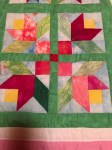
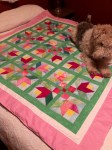 Miss Molly is examining the quilt.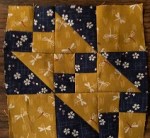
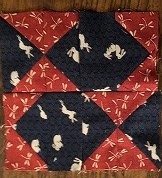
 I have finished 25 of the 169 center blocks of the Dear Jane quilt. That is not counting the border triangles, but I will think about them when I finish all 13 X 13 rows of the center. Each block is hand quilted and bound in the pot holder method. Then they are sewn together. I’m really addicted to making this quilt even though I once said that I would never make a Dear Jane.
 I have also finished a small embroidered wall hanging. I embroidered a Donna Dewberry pattern. Her embroideries look similar to her painting. She uses many colored threads in the embroideries and sometimes repeats a color. When I sew the embroidery, I do not have a backing in the hoop. I heavily starch the fabric and add batting. I first sew a tracing line around the hoop. It outlines the pattern. Then, after the embroidery is finished, I add the backing and use the line to add the first border. It makes a straight line and automatically centers the embroidery. I usually have two borders and stitch a feather stitch on the seam lines. This attaches the top to the backing. The binding is cut smaller than the binding for a large quilt. I like to hand tack the binding down. On some small quilts, I add a flange binding. It requires no hand work as it is sewn to the back of the quilt and turned to the front. These little quilts ( 12″ X 12″) are almost instant gratification.
 I searched for a pattern to use all those colors and decided to make a king size quilt using squares sewn together, cut again at an angle using a template and then sewn back together again.
 The first one that I made has been hanging in the top of the living room in the Maine house for fifteen years. The other is a small table mat.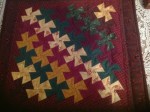

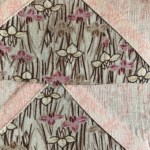
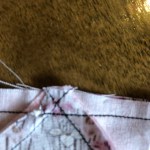 It is because your joining line was sewn below the X on the head of the geese. This is the X .


 Miss Molly quilts