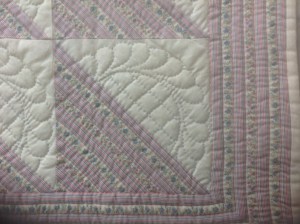
I looked up the definition of friends on the internet. It says a person who one knows and with whom one has a bond of mutual affection. Then I pulled an old Funk and Wagnalls dictionary from the shelf and found these synonyms – chum, coadjutor, colleague, companion, comrade, consort. fellow, helpmate, partner, peer, an associate. Then the dictionary went on to tell how the terms were applied to the word friend.
In our lives, we have many different friends. Some are neighbors, some belong to a group that you belong to, some are classmates from the past, some just pass through your life, making it better for a while. Friends come and go. We do loose track of some, but we pick up right where we left off if we meet again. Most of our friends do not know our other friends.
One of my group of friends is my Maine Guild. Every year, we have a Christmas in July pot luck supper . What great cooks! We have great food and lots of fun. After we eat, we have a Yankee swap. We swap ’til we drop. It is so much fun. During different years, I have had the privilege of going home with three wall hangings made by friends.
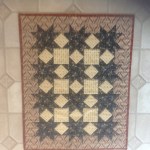 Nancy’s wall hanging was the first one that I received when the swap was over. Her quilts were perfect. It is 15″ x 19″ Another year, she received a small wall hanging that I made.
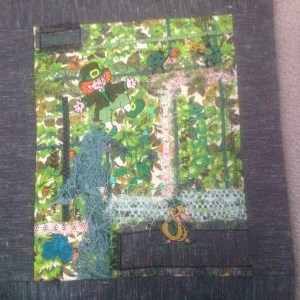
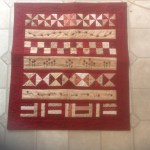 I always wanted something from Shirley. She is a master of the mini quilt. This one is 17″ x 19″ I had watched her work on this quilt at another group meeting and really liked it. Every year, at the Yankee swap when I got something from Shirley, someone took it away from me. I thought that I would loose this little quilt, but the last person in the swap chose something else.
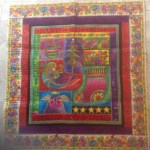 I went home with Claire’s quilt the last year that Claire was with us. She moved to Florida and I have such fond memories of her. I could have swapped for other items, but I wanted a memory of Claire.
Three friends, three quilts, three memories.
Have a great day and happy quilting
 The first was made from two paper pieced flowers. I don’t remember why I made them. They have been in my stash for a long time. My sister in law gave me a toilet paper cover for Christmas. It was knit in Christmas colors, As pretty as it was, when the season was gone, I put it away. The two flowers looked about the same size so using the knit piece as a pattern, I designed a cover. I enjoy adding piping to quilt pieces so piped around the top. It looks like Spring.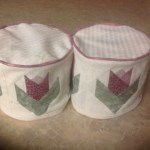
 Last June, I had a class at the Vermont Quilt Festival with David Taylor. He taught Invisible machine applique. It is an quick,easy, and fun technique. The piece, Under the Apple Tree, was completely appliqued in the class. Then it has sat in my ufo stash until this week. It just needed the border added, quilting and binding. It is 12″ x 12″ so didn’t take long.
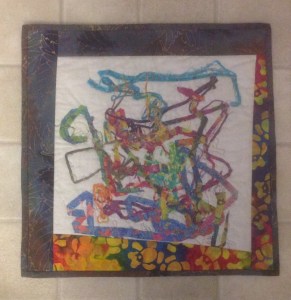 When I made the Garbage to Gaa-barge series, I belonged to a group called the Tuesday night quilters. We had lessons and sewed challenges and round robins. At one meeting, a member was making a baby quilt. The fabric was unusual. It was not baby quilt fabric. When it was finished it was awesome. A baby would love to bright colors.
 My Christmas cactus has outdone itself this year. It has been blooming continually since Thanksgiving day. It must like how I care for it. It is in an east window. At night, I pull the insulated drapes around it, leaving it to the evening window chill. It apparently likes to be cold at night.
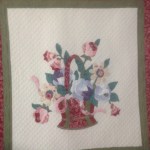 Basket is a Nancy Pearson pattern. It is hand appliqued and hand quilted. 25′ x 25″
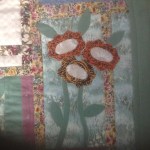
 Rose is also hand appliqued and hand quilted 18″ x 18″ It has a double row of piping on the border.
 Stone Soup was made from a stone soup challenge. A bag was filled with different criteria from fabric stashes and then traded with other quilters. When I opened my bag, I found that there were two different colorways. One was red, white and blue, the other was pastel. They didn’t seem to fit in one quilt so I made two and joined them at the top. They fit over the back of a chair.


 We had already purchased the tulle and cut it into 10″ strips.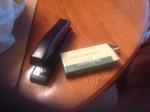
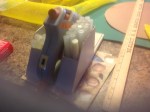
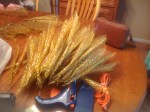 The strips were rolled on a diagonal and the bottom stapled.
 The rolled strips were stapled and glued to a circle that was made from a pizza box. Two holes were punched into one side of the circle for the wire to hang the finished wreath.
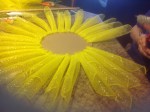 There were three rows of rolled strips. The middle was made from brown burlap that was glued onto a smaller circle.
 Each of us had different color tulle and the sunflowers were very different. We had a great day with fun, laughter, and fellowship. Not to mention the most delicious lunch.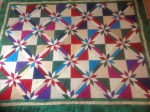
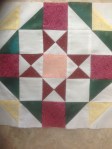
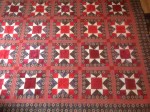 Several years ago, I demonstrated the Lazy Girl Flying Geese ruler It makes four geese at a time. Again, I did the demo five times. There were a lot of cut out pieces. Those pieces sat for a long time until a Guild challenge was to finish a UFO. I pulled the pieces out and finished the quilt.
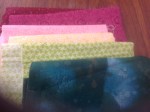
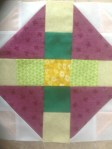 It looks as if one light green jumped from one fabric pile to another. It’s o.k. as that color is in both pictures.
 The spiral runner was made with from a pattern “Spicy Spiral Table Runner” by School House Quilts. It is made with a 10 degree ruler. The fabric was strip pieced and cut and then sewn back together. Organization is the key to keeping the strips in order.
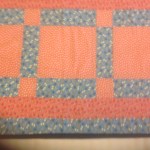 This table runner is made from a “Piecing with Poppers” pattern by Sharon Mayers. The poppers make a big difference in the piece. I pieced the back the regular way and the front with the poppers to show the difference. The “poppers” really do make the quilt “pop.”I have other Sharon Mayers patterns and will make them in the future.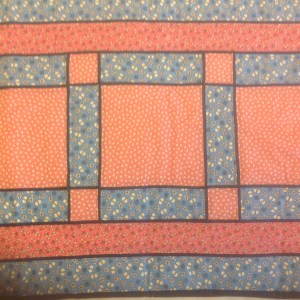
 I was having a dinner party the first part of March and thought a green table runner would be great to celebrate St Patrick’s Day. This pattern is a free download from Connecting Threads, I sewed it together a little different than the instructions. It called for cutting each piece separately, I sewed the sections in a strata and then cut the strips.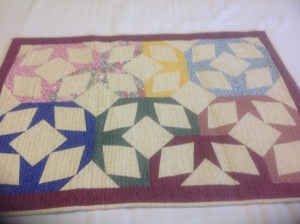
 This runner was made with the flip and sew method. It was quilted as I pieced it. I’m not sure which pattern I used as I have many patterns with this runner.
 This is another Connecting Threads pattern. It looks difficult to make, but in reality is very easy.
 For the first wall hanging, I went to the back yard and picked up leaves, The leaves were used as patterns. Each leaf was fused together with a backing, making a double sided leaf. The piece was machine quilted before the leaves were attached, After stitching around the leaf shape with a zig zag stitch, they were attached to the piece with built in embroidery stitches, stitching down the center and leaving the leaves free standing.
 Moonlight is made with discharge dyeing. When you discharge dye, you never know what color will remain on a black piece of fabric Every black has a different base color. I picked leaves and branches from the yard. Using a foam brush, I painted the leaves and branches with bleach and pressed them on the black fabric with a brayer. It is important to have a bucket of vinegar and water prepared ahead of time so the fabric can be immersed as soon as the bleach has done its job. After the fabric had dried, I made the moon. A circle was cut out of freezer paper and the paper was pressed in the middle of the piece. Bleach was spritzed from a spray bottle. Again, the vinegar rinse is ready for use as soon as the discharge looks like you want it to look. Quilting with gold thread brought the leaves to life.
 I had a class with Sarah Ann Smith at the Vermont Quilt Festival. We painted the leaves with a metallic paint stick and then machine quilted around the with metallic thread.
 For the first challenge, we were given a piece of striped fabric and instructed to make something from that fabric. We could add any other fabric that we wanted,
 I made this little wall hanging. It is hand quilted. I only did hand quilting at that time.
 There was fabric left, so I made a second wall hanging. It is very simple, just half square triangles. It does look as if I did a lot of piecing. I like this one because it is simple, yet very striking with the hand quilting.