
It’s almost the end of 2018 and I did not reach my goal of finishing one UFO each week. It doesn’t really matter as I have finished some and the basket is isn’t as full as it was at the beginning of the year.
I did start and complete several quilts. Some are still at the long arm quilter. Some, I quilted myself on my domestic machine.
I have lots of plans for 2019 but there will not be as many long term quilts as this year. I still have seven Moda blocks to make. There will be a few more next year. After I finish the Moda blocks, the Dear Jane quilt will be the only long term quilt project to work on. There are a few bonus blocks to make for the Splendid Sampler project. Then, that project will be finished. The Temperature Quilt top will be finished this week. I have found two patterns that can be made out of the Japanese fabric.
When I have a few minutes and just want to sew, I work on a Mile a Minute block. There is no thinking in making a Mile a Minute block. I keep a bin of cut off fabric near the sewing machine to use when the mood strikes. Soon, I will have enough to make a “free” quilt top. I also have a basket of squares that work up into nine patches for Linus quilts.
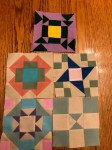
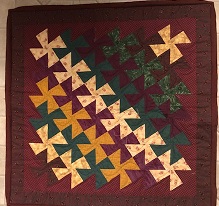 This week, I finished three UFOs. The first one was made years ago. It is hand quilted. This month, I started keeping hand quilting and applique near my chair. It’s handy to pick up and work on it while watching TV. This is a fun pattern. Squares are cut and sewn together. Then, using a plastic template with cross marks, the squares are recut and sewn. It is made with all straight seams, although it doesn’t looks that way. There are small pieces left after the second cut. If the pieces are kept in the same sequence, a smaller version of the quilt can be made.
 The blue and green table runner is machine quilted. I practiced quilting it with circle rulers of different sizes. It has been in the basket for a while because I didn’t like the quilting. Today, I stipple quilted the blue pineapples and finished it. It is much better now.
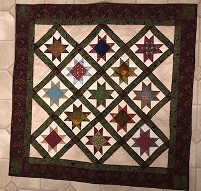 The star piece is small. It is hand quilted. I like the colors. Somehow, setting the blocks on point make the quilt look better than a straight setting. I can see a large quilt made with the small stars. Maybe, some day I will make a lot of stars and make a bed quilt. It would be a stash buster. Some of the Mile a Minute fabric is large enough to make small stars. I may start putting the larger pieces aside for that project.
I have finished three small tops and they are waiting to be packaged and quilted. They shouldn’t take too long. It would be nice to finish three more this year.
Have a great day and happy quilting.
 In 2009, I made wall hangings for each of my daughters, my daughters in law and one granddaughter. They all came for Christmas that year except for one daughter who lived in Virginia at that time.
 Several years later, another daughter mentioned that her favorite silly Christmas song was “I want a hippopotamus for Christmas”. I just happened to have a hippopotamus pattern. I retrieved the put away quilt from the attic and used it to make the hippopotamus. My daughter got what she wanted for Christmas that year.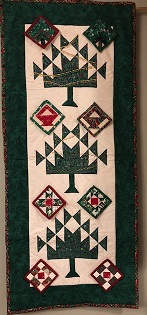

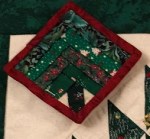


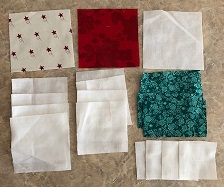
 Fold 2 3/4″ white squares for row one in half diagonal. Press. Position one in each corner of red fabric, having fold toward center and raw edges along outside edges.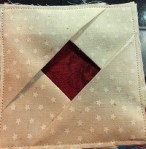


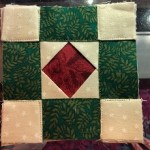
 Fold 3″ white squares for row 4 in quarters. Press. Align point of square with center diamond. Secure. Trim away excess.


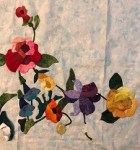 Wouldn’t it be nice if the flowers actually bloomed in the garden at the same time. That’s the advantage of growing flowers on fabric.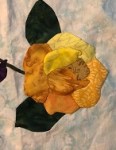

 The day lilies come in so many colors. Many of my lilies have reverted back to orange. The ones that didn’t revert are beautiful. I take pictures of the same flowers every year. I should separate the bulbs next summer.
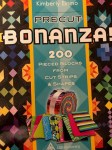 I’ve started another squirrel quilt. It is one that is not planned, but just has to be made. It has to get out of my mind. All other quilts are put aside until the squirrel quilt is made. When I bought Kimberley Einmo’s book, I decided that I would make all of the blocks. The 10″ blocks have been made and are in a quilt that is waiting to be quilted. That quilt was made last summer. It is the next one to quilt.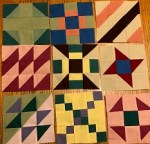
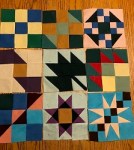
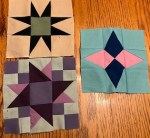
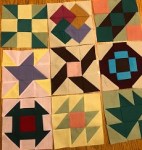
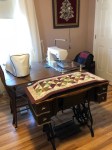 I have space for two quilters in the sewing room. The second machine belongs to one of my daughters. She pieces quilts when she stays with me. On occasion, we sew together. It is so much fun to quilt together. My machine overlooks the window. I can watch the world go by as I sew. The new house across the street is almost done. Someday, I will watch my new neighbors move in.
 Last weekend, I finished most of row D. I had intended to make the blocks from the center out, but changed my mind and worked on a row. Row D will go across the top of the center blocks. All the finished blocks have been hand quilted and bound. The quilting is minimal. Just enough to hold the block together. After all, it is only 4 1/2″ square. It doesn’t need much quilting. There is only 20″ of binding to tack down.
 I still remember saying that I would never make a Dear Jane quilt. There were too many small blocks. It was a copy of another person’s quilt. How very boring. Now I find that it is a lot of fun making each block and seeing the pile of little blocks add up. I’m glad that I went to the Dear Jane club just to see what was going on.
 The Christmas wall hanging is finished and is on the wall. There was a slight delay because I misplaced the fabric that I had intended to use for the binding. It was the same fabric as the background. I went to the quilt shop and bought a piece that I thought would match, but when I got home, it was nothing like the background fabric. So much for thinking I knew what I wanted and didn’t bother to bring the wall hanging to the quilt shop to check.
 There was enough of both fabrics to make the flange binding. The binding portion of flange binding is cut 1 1/2″, not the 2 1/4″ or 2 1/2″ as you would for regular binding. The flange portion is cut 1 3/4″. After the two pieces are sewn together, it is sewn to the back of the quilt and then rolled to the front and sewn down in the seam where the two pieces meet. This is a great way to make a binding if the fabric is a little short for regular binding.
 Another flower has grown on the wall quilt. I applique in the evening and the flowers are growing very slowly. The newest flower is a blue trumpet flower. Just to the right is a partial small yellow rose. I’ll finish that tonight. Most of the templates have been cut out for the rest of the flowers. I just need to take a day and sit and tend to the garden. I have changed the flower colors several times. I could finish the quilt faster if I used my first choice of colors.
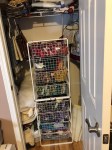 Behind door #1 is one of the Ikea units. Batting is kept on the floor on one side and stabilizer is on the other side. Backings are hung on hangers. On the shelf are quilt tops that are ready to quilt. You can see that I am a little behind in quilting the tops.
 Behind door #2 is the second Ikea unit. Craft bins are on the left. They contain UFO’s that I take out once in a while and work on them. There is a Cynthia English piece that I can work on only for a short time. Then it goes back into the closet. It will be finished someday. The right side contains a bar that I’m going to use some day to hang a design board. Also other things that I might use some day. On the shelf are bins that hold most the wall hangings that I’ve made. Also wall hangings that my friends have made for me. I enjoy looking through them every once in a while.
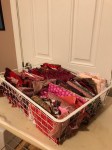 The drawers of the Ikea unit are removable. I can take them out of the closet to find what I want. If you check the bottom of the unit in door #2, you will notice that the drawer is missing. All the fabric, patterns, and supplies that I need for the wall quilt are in that drawer. It is on the kitchen island. When I want to sit and sew, everything is right there for me. When the wall hanging is finished, I’ll put the leftover fabric back in their proper drawers and use that drawer for the next project.
