
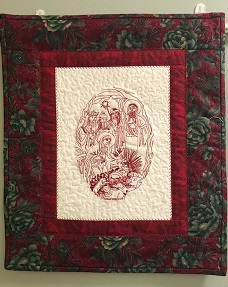
 It’s December. This year has flown by. My monthly wall hanging has been changed. It’s nice to have a different one on the wall each month. I notice that some of my friends and neighbors have their Christmas decorations in place. I haven’t even thought about it, except to work on the Christmas wall hanging from two years ago. It is almost ready for the binding, so I think it will go on the wall this year. The quilting has made it look much better than I thought it would. I should finish it in the next two or three days and then it will go on the wall and I can bring the Christmas decorations down from the attic.
As I have been quilting the Christmas wall hanging, I am able to look out the window and watch the workmen build a garage at the new house across the street. They put prefab rafters on the garage today and started to close in the roof. A Bobcat smoothed out the front yard. I can’t imagine that they will grass it in December, but it will be ready for the Spring. I’m so glad that I moved the sewing room from the back to the front of the house. Now I can watch the world go by as I sew.
 The Temperature Quilt has eleven months finished now. I can see the colors on the right side changing to the colors on the left side. It makes the quilt look even. It’s not a spectacular quilt, but I like it. It was fun to check the temperature every day. I found that I didn’t use the fabric below 0 degrees or above 100 degrees. Maybe we will have a day this month in the frigid zone. I found a large piece of batique fabric for the second border. The first border is black, the same as the sashing, only a little larger. There is a lot of batique fabric left over. I’ll have to design another quilt to use it up. It seems as if I only make scrap quilts. I do have a challenge quilt to make that is not scraps. I’m looking forward to making that one.
I’m taking a break from the Moda Blockbuster blocks of the week. I still am saving the weekly patterns and will make them at a later date. The Splendid Sampler free blocks have stopped, but I still have a few bonus blocks to make. The blocks are only 6″ square so I will check Sharon Craigue’s Setting Solutions book for a way to make them all largerand make a bed quilt.
Have a great day and happy quilting.

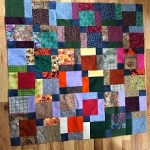 I made nine patches for the smaller piece. I didn’t want to use sashing, so I cut each nine patch in half vertically and horizontally. Then I rotated two of the pieces and sewed them back as a four patch. It made all the colors blend. I need a border for the piece to hold all the colors in. Maybe blue, like the small squares or black. Maybe even white. I’ll audition several fabrics and see which color is best. When I was done, I had two squares left over. I cut them down to 3 1/2″ and put them in the drawer with the others.
 When I changed my sewing room from the small office/ library/ sewing room to the guest room, the first thing that I did is have the carpet removed and Pergo installed. I am so glad that I did that. It is so easy to keep the floor clean. No vacuuming up dropped pins. As the room is still the guest room, I bought a day bed. It has three drawers and a trundle bed under it. It is taller than most beds, but is great for sorting and laying out fabric.
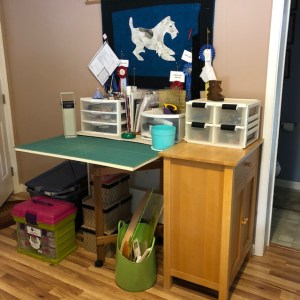 The cutting table has only one leaf up. Plastic drawers on the back hold supplies. A little ruler holder on top holds the small rulers that I use most and the rotary cutter. The larger rulers and pressing supplies are in the large garden bin under the table. Sewing machine instruction manuals ,a few patterns and blank paper are between the drawers. I still have a lot of work to do to get my supplies in the proper drawers. My back was to the overhead light and it was hard to see, so I put the Ott light on the table. It is much easier to cut now. The Ott light also shows the real color of the fabric before I cut. The tool box holds all the gadgets that I just had to have. The blue bin behind everything holds a few UFOs Maybe I will get to them, maybe I won’t. The bureau should be in the office as it used to hold office supplies. Now, It has mile a minute fabric, other fabric that I am gathering for a quilt that I will make in the future. and a lot of junk that I should go through and sort out. I use the wall hanging to pin patterns that I want to make next. Also the strips for the Temperature quilt before I sew it to the main body when the month is over. It’s like a bulletin board.
 Tonight, I worked on the wall quilt. I love to applique, but for some unknown reason, I’m having a hard time appliqueing the pieces down. I haven’t appliqued for some time but I should remember how to do it. The big rose was easier to applique than the small rose, so maybe by the end of the week, I will be doing better.
 I’m appliqueing with bottom line thread from Superior Threads. It is a fine thread. Using the proper color, the thread disappears. When I saw the bobbin case full of the different colored threads, I knew that I should find every color that I needed. There is a lot of thread on the bobbins. I do have to use short lengths of thread which is o.k. as each piece of fabric that is appliqued is small.
 As I laid each piece on the cutting mat, I cut the largest square that I could. Then, I cut smaller and smaller until the whole piece was gone. Some pieces could be laid on each other and several squares could be cut at once. My favorite ruler is the Tucker Trimmer. It had a workout the past few days.
 The larges square was 5 1/2″ I will put them in the drawer with other charm squares. There should be enough squares that size for a quilt.
 I think that I did cut enough 4 1/2″ squares for the quilt that I want to make. Maybe even enough for two quilts.
 The next size was 3 1/2″. I can make nine patches for Linus quilts. I have several flannel pillowcases that I will cut apart for the backing for baby quilts. When I get to it, I’ll figure out how many nine patches I need to fit the pillow cases. I should be able to make several quilts with this size squares.
 The smallest square in 2 1/2″. There are over 1,000 of these small squares. I have seen pictures of quilts made with this size square. One will surface when I get to use this batch of squares.
 As I was cutting and throwing away the small scraps, I remembered the time when I kept every little scrap for the Gaa-Barge project. I decided to save some of the little scraps to finish that project. I had planned to make one Gaa-Barge a week for a year. I made only 32 so I have 20 more to make. The small pieces saved in this box will be enough to make all 20 quilts.
 I did sew for 10 minutes on the quilt. It won’t take long to finish sewing the top. It sews together beautifully. The quilt will have one row of colored squares, then a row of white sashing. The last row will be the colored squares. That will be the border. Because the sashing is cut 2 1/2″, the 4 1/2″ squares line up perfectly on each row. I could make a smaller version of this quilt with the 3 1/2″ squares with 1 1/2″ sashing. It’s a thought. I’ll have to figure out how many rows it will take to be the same size as the flannel pillow case. Maybe I could sew two pillow cases together and make a larger quilt. Half the fun is in the planning.
 The first flower has been appliqued on the wall quilt. It is the rosebud on the top of the swag. The next flower is a large rose. There are also day lilies, poppies, and trumpet flowers. I am going to applique the flowers on the right side before I choose colors for the left side. They will be the same colors, but I want to balance the colors in the piece. I should probably do applique during the day instead of in the evening when I’m tired and watching TV. I think that they would look a little better. All the fabric and diagrams for the wall quilt are now contained in a wire drawer. The drawer can be removed easily when I’m working on the wall hanging and put back, out of sight, when I’m not working on the project. The line in the fabric is the cross line to match up the blue fabric to the master pattern. There is also a horizontal pressed line.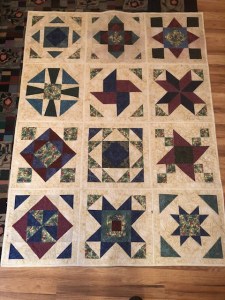

 The three cousins had visited Miss Molly in Maine last summer. They had a good time, except that Odie took over Miss Molly’s spot of the sofa.
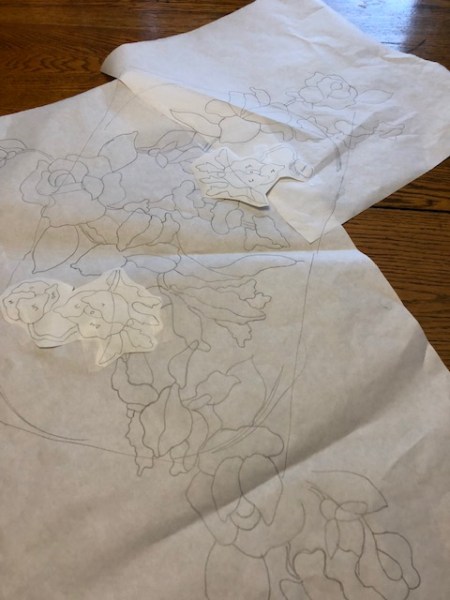
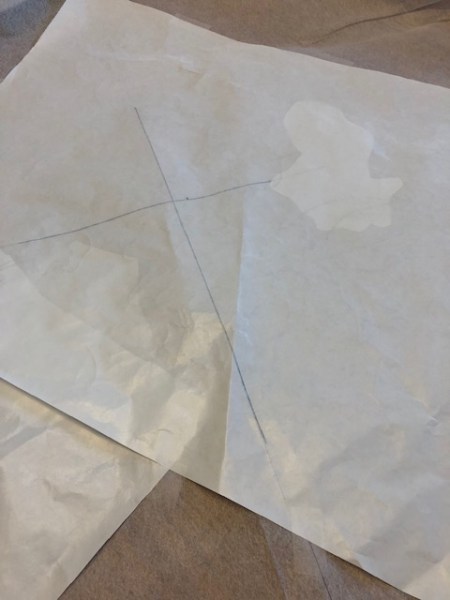
 Then, using the light box, I transferred the pattern to a large piece of stabilizer. This stabilizer pattern will be the diagram for placement of the applique pieces. The hardest part is figuring out which pieces should be appliqued first. The freezer paper diagram will be cut out for the patterns. I haven’t decided whether I will cut out and applique each flower separately or cut out and number all of them.
  I want to use the flowers from my garden for color inspiration. Several photos are in the file and I placed them where they should go so that I can see how it should look. I may look in a flower catalogue for other color inspiration. My flowers are very similar in color. I’m still deciding which fabric will be the base for the appliques. There are two contenders.
 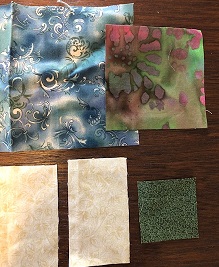 1 -3 1/2″ dark medium square, 1 – 2″ square of dark medium, 2 – 2″ x 3 1/2″ of light and 1 – 5″ square of dark medium.
Stitch together with a 1/4″ seam like this.
1 -3 1/2″ dark medium square, 1 – 2″ square of dark medium, 2 – 2″ x 3 1/2″ of light and 1 – 5″ square of dark medium.
Stitch together with a 1/4″ seam like this.

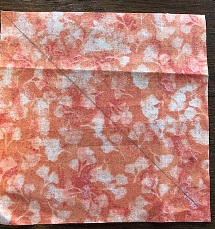 Draw a diagonal line on the 5″ block.
Place onto the pieced block RST with the diagonal line beginning and ending on the light rectangles. Stitch 1/4″ on each side of the diagonal line. I pinned the two pieces together so that they wouldn’t shift.
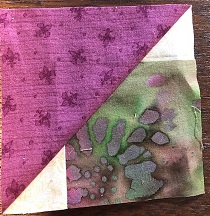
Cut on the diagonal line to create two squares. Square to 4 1/2″ There is just a sliver to cut off.
Draw a diagonal line on the 5″ block.
Place onto the pieced block RST with the diagonal line beginning and ending on the light rectangles. Stitch 1/4″ on each side of the diagonal line. I pinned the two pieces together so that they wouldn’t shift.
Cut on the diagonal line to create two squares. Square to 4 1/2″ There is just a sliver to cut off. One square will look like this.
The other will look like this.
One square will look like this.
The other will look like this.
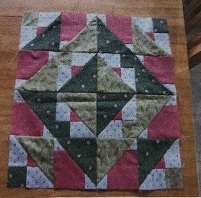 Assemble to create a pleasing design. Use lots of scraps for a different look. You can use charm squares for the 5″ pieces.
The picture of the square has 16 – 4″ pieces. I found that if you want a block that is color coordinated like the one in the picture, you have to make four squares in two different colorways.
An other possibility would be to make a 4 patch block with the pieces twisted and turned other ways. The blocks are so easy to make. It would be fun to make several and play with a setting. I do have a lot of 2″ off white strips leftover from another project. If the background was the same color, it might work.
Have a great day and happy quilting.
Assemble to create a pleasing design. Use lots of scraps for a different look. You can use charm squares for the 5″ pieces.
The picture of the square has 16 – 4″ pieces. I found that if you want a block that is color coordinated like the one in the picture, you have to make four squares in two different colorways.
An other possibility would be to make a 4 patch block with the pieces twisted and turned other ways. The blocks are so easy to make. It would be fun to make several and play with a setting. I do have a lot of 2″ off white strips leftover from another project. If the background was the same color, it might work.
Have a great day and happy quilting.




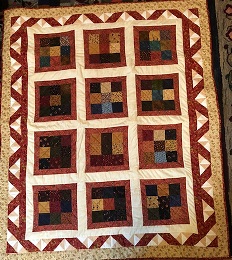 I saw a beautiful quilt on the Missouri Star Quilt Company web site. It was a simple nine patch that was cut and the pieces turned in a different direction. It was different than the other blocks that I had made. The nine patches were set without sashing. I decided to make half size blocks so that I could make another Linus quilt with the technique. Nine patches are easy. I didn’t need to look at the tutorial to make them. The nine patches sewed up quickly. Somehow, it didn’t look right. I went back to the tutorial to see how the nine patches were cut. That’s when I discovered my big mistake. Five of the pieces of the nine patch were supposed to be white. I used all dark and medium pieces. They would have made a very dark quilt. That’s when the quilt was named “The Mistake”. I decided to put white sashing between the blocks and add an unusual border to take the eye away from the center. It worked. It turned out to be a pretty quilt. Maybe I should rename it “Lemonade”.
